Showing posts with label documentary. Show all posts

Saturday, May 18, 2013

IndieFlix and supporting documentary filmmaking


The hardest part of documentary photography is getting your work seen.

I’ve written before about how some of the world’s documentary photographers struggle to get their award-winning published. There simply aren’t enough news-focused magazines to support the medium, financially or otherwise.

For those who have not gained a foothold at the picture desks of the British supplement magazines or the American and German markets, the challenge of getting their work scene is even more of a personal Everest.

Those who turn to the internet find shrinking hope. While online platforms are able to display images beautifully, the reality is that a personal website generates only passing glances.

The images we consume online these days are increasingly social media-led – either images from friends (Facebook and Instagram) or through apps, a kind of curated best of which often only considers work made available through agencies. The independent artist has been slowly squeezed out of the picture.

But perhaps there is a glimmer of hope.

For documentary filmmakers, who for so long like stills photographers are underpaid, underexposed and undervalued, there is an organisation created in 2005 called IndieFlix.


IndieFlix says about itself: “For far too long, filmmakers have been forced to either sell out or starve. Thousands of brilliant, creative minds submit their works to festivals, hoping to catch a meaningful audience. Fewer than one per cent actually break through. As if finding the financing and making the movie wasn’t hard enough in the first place. We’re here to level the playing field.

“Founded by filmmakers, IndieFlix is part champion, part curator. We’re so inspired by independent filmmakers and the work they produce, we’ve created a stellar platform for you to discover the best and quirkiest around.”

NOTE: IndieFlix asked me to review their service in May 2013

Monday, August 20, 2012

Marlboro Nights, Come To Where The Smoking Was (looking back at the ban on smoking in public)

[gallery]My six-week exhibition at The Continetal in Preston has just come to an end.

Marlboro Nights the exhibition marked the fifth anniversary of the ban on smoking in public in public in England (July 1, 2007).

Marlboro Nights the book is availble now on Amazon in the UK and the US.

This big brash book documents smokers before the ban and then follows them as they were forced to go outside. Some of the portraits can be found elsewhere on this blog (or on www.gazcook.com where you can buy a signed copy from the store), below are some lovely landscape shots.

Garry_cook_smoking_028
Garry_cook_smoking_005
Garry_cook_smoking_010
Garry_cook_smoking_019
Garry_cook_smoking_021
Garry_cook_smoking_030
Garry_cook_smoking_031

NOTE:

Smoking_kills2

Monday, June 25, 2012

Is the Daily Mail the saviour of documentary photography?

Garry_cook_daily_mail

The Picture Post was a British photojournalism magazine in circulation between 1938 and 1957.

Since the Picture Post’s demise, documentary photography has suffered a long and slow death in this country.

Publications showing in-depth photo essays have dwindled over the decades. Hardly any exist today.

Newspaper magazine supplements – such as Sunday Times Magazine, Guardian Weekend magazine and Telegraph Magazine – were once proud adversaries of documentary work. 

But from their 70s and 80s photojournalism heyday, these supplements have chosen to cut back on their once impressive documentary coverage in favour of celebrity driven content.

While there has been the occasional renaissance in coverage, the Sunday Times Magazine’s Spectrum strand springs to mind, the British press has largely become a wasteland for photojournalists.

But over the past 12 months something quite remarkable has happened – photojournalism, or at least a bastardised version of it, has become increasingly popular thanks to an unlikely source.

Step forward the Daily Mail, a British middle-class tabloid better known for whipping up scare stories and savagely attacking any woman deemed past it who dares to give herself a makeover.

The Daily Mail Online is officially the world’s most read news website (though you could argue that the New York Times website still has more hits if you take away views from the Mail’s sister titles). We are talking 45 million hits in a month (December 2012)

The British Guardian newspaper produces innovative photographic slideshows and actively promotes documentary photography online.

But the Mail Online beats it hands down with a fast moving, celebrity-driven front page with long title headlines which are optimised for website search engines.

Strangely, the stories you find in Mail Online are hugely different to much of the content in the print version.

But what editorial staff at Mail Online have quickly realised is that as well as a thirst for tittle-tattle on Cheryl Cole and Rihanna, readers also love a photo essay.

And the Mail duly serves up photo story after photo story, with collections of images ranging from the British weather, archived black and white collections and, more recently, documentary essays on subjects like Gypsy travellers and the Chinese culture of eating dogs.

Sadly, all of these stories are subject to the Mail’s derogatory spin, which can be xenophobic and prejudicial.

But the sheer volume of photoessays, sourced from various agencies, are giving a new platform to essays from around the world.

The discovery that there is a news-hunting audience out there ready to devour photo essays is a huge boost to the photography industry.

As the hits mount up, expect more online publications to follow suit and give documentary photographers new avenues to showcase their work.

Friday, June 15, 2012

Alternate look at Wadi Rum

As well as it's stunning landscape, Wadi Rum is also home to the semi-nomadic Bedouin people.
2012_may_jordan_064
Garry_cook_wadi_rum_jordan_004
2012_may_jordan_093
2012_may_jordan_071
2012_may_jordan_095
Contrary to popular belief, these people are more Westernised than you would think. These images include the Bedoouin town of Wadi Rum.
Garry_cook_wadi_rum_jordan_002
2012_may_jordan_086
2012_may_jordan_089
Garry_cook_wadi_rum_jordan_001

Monday, October 17, 2011

An interview with Garry Cook

[gallery]
Garry_cook_photography_manchester_station
Garry_cook_photography_london_underground
Garry_cook_photograpy_british_rail
You interviewed four paedophiles in Holland - what drew you to that and how did you find it?
Paedophilia is a very difficult subject and because of that it is hardly ever discussed. The media has a role to play in this area and, in this country, it has failed to contribute to managing the problem. How many people know if paedophilia is a disease, is hereditary or just a choice by one person?
We need to know more about the subject because the present system of dealing with it – which is led by the media, particularly the printed press – is to condemn the perpetrator, expose them and hound them out of their homes.
But these people have to live somewhere and surely it is far better to try and manage them in society rather than force them underground where the situation can, and often does, worsen. In Holland there are politicians and individuals willing to speak about these issues and the media reports on some of this with some intelligence. It is a hugely different way of thinking to here in Britain. 


You've done a photo project of Hebden Bridge, a quiet and picturesque town in West Yorkshire which is quite at odds with some of your more gritty work - why did you choose it as a project?
Because part of my work aims to attract more people to photography as art, projects like my Hebden Bridge images are important. It is a simple set of images documenting a town, its people and their way of life.
I am applying the same principles to this kind of project – to document and record, but am including less people and more landscape imagery. This traditional subject-matter is more accessible to people who don’t live and breathe photography and these are the people photography as in industry needs to attract if it is to survive as a profession.
At the moment photography – and I’m talking of documentary, editorial, street photography and social issues photography – is struggling because there are so few avenues for it to be seen and to be sold. The Hebden Bridge project is part of the Love Town series and will soon be published in issue three of the Love Town zine.


How did you get involved with Control and how have you found it collaborating with others?
The two exhibitions we have put on this year, in Liverpool ad London, have been superb. In Liverpool we got ourselves a very rundown warehouse and put on a show without electricity but with free running water – down the walls. It was a spectacular success, even hosting one of the big corporate events during the Look2011 International Photography Festival we were part of.


In London we have Oxford House, a quiet stunning venue in Bethnal Green. I don’t think we would have got the venue or been part of Photomonth, the East London Photography Festival if it wasn’t for one or two members of our group, particularly Pablo Allison and Ann-Marie Conlon who new the venue and had contacts within the festival. It’s these kinds of things which makes collaborating a joy.
But collaborating with others is not always easy. I put on a show in Blackpool this summer in less than two weeks, working with just the curator, Tom Ireland. It was fast and easy. With Control we give ourselves six months build-up to each show we do and at times it can be confusing to keep track of what has been decided and slow to agree to a proposal.
Somehow we ended up launching the show several days before the preview night which means two trips to London inside a week. I couldn’t tell you why this happened but it’s one of those group problems where the majority rule sometimes over-rides common sense.
There are usually nine or ten of us involved in Control. We have been lucky in that we are a placid lot but when people don’t reply to your emails – and often you feel you don’t need to reply because you agree with what’s been proposed so don’t feel the need to comment – it can be frustrating. I’ve been on both sides of this scenario and no-one is really in the wrong but it can make you wonder why are you putting in the effort but are getting nowhere.
Of course, come showtime everyone is delighted and these problems are distant memories. We keep up-to-date via an email group but so much information can get lost very quickly. The problem is we haven’t found a better way of communicating. Someone suggested Blackberry messaging but there was nearly a riot.
Control is a fantastic exhibition, examining the theme of Control in people’s lives through some hugely diverse styles of photography and subject matter. For my strand, Women and Alcohol, you get to see images of women getting drunk. It’s one of the more light-hearted projects in the exhibition.

Anything else you'd like to add?

I’m really keen to put on an exhibition in Preston during the Guild 2012 celebrations. I’m looking at documenting Preston’s diversity. For this I’m hoping to work with community figures to help me reach out and find inspirational and people to photograph, and also want to involve local business to help finance the project.

Control: www.thephotogroup.co.uk
More photographs at www.gazcook.com
The Love Town zine is available to by at www.lovetown.eu
The love Town podcast is available to download for free on iTunes at http://bit.ly/lovetownpodcast


Sunday, May 01, 2011

Royal Wedding street party in Whalley, Lancashire

[gallery]


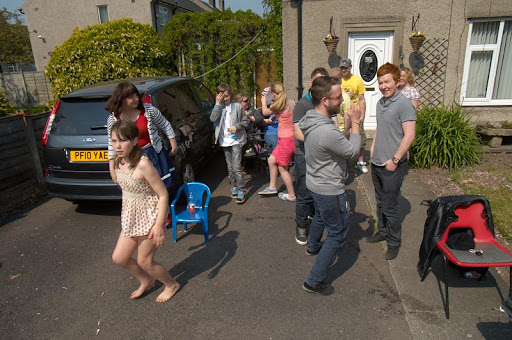
April 29, 2011 - the Royal Wedding. It was a Bank Holiday across Britain. We had street parties to celebrate. Thes two featured here where held in the Ribble Valley town of Whalley.


Royal Wedding street party in Whalley, Lancashire


April 29, 2011 - the Royal Wedding. It was a Bank Holiday across Britain. We had street parties to celebrate. Thes two featured here where held in the Ribble Valley town of Whalley.


Monday, January 03, 2011

Phonar open University

It’s education with a difference.

The third-year degree course, held at Coventry University in the United Kingdom, has eleven students in its class.

But it’s the Photography and Narrative module which is groundbreaking. Known as #phonar on twitter, this course is accessed by over 100,000 users online.

#phonar is is free and open to anyone around the world.

Now this is where it gets difficult to take in.

I’m well-versed in theories of freeconomics and, specific to photography, how distributing images for free can contribute to viable business plan (it’s a bit like Prince giving away his album for free in the Daily Mail and then charging £100 for a concert ticket for one of his 21 consecutive gigs at the 02 Arena).

But this ten-week course, which explores the practicalities of how story-telling photographers can survive financially*, involves contributions from users around the world (latest stats for six days in mid-December 2010: 1,853 different people from 434 cities over six continents). The website has only been online for two months. Blimey.

What I can’t get my head around is how a small undergraduate course finds itself reaching such a staggering number of people. But as lecturers investigating new business models in photography, I guess I should not be surprised that they know how to market their project.

Photographer Matt Johnston masterminded what he calls the ‘strategies for social media leverage’. He was reluctant to reveal his strategy but said: “We have worked hard to ensure we create something that people not only want to read, but want to be a part of, and can see the value in sharing and engaging with."

If there’s one recurring complaint I have about photography and journalism degree courses it’s that they don’t examine closely enough what skills will actually make you money.

A course like #phonar is therefore worth it’s weight in gold – and the fact that it’s free and open to all is brilliant.

* This is my description. Worth describes the course in more academic speak, looking at the ‘development of a sustainable practice.”

50blogs3

By using their extensive network, #phonar has also produced a list of inspiring photography blogs.

Tuesday, October 26, 2010

Merry Christmas! cards images

These quite wonderful* images document Christmas in modern-day Britain.

They have been published as a limited-edition set of 12 cards to promote photography. The idea is that the product (cards) promote the image. This is in direct contrast to a tin of beans where the image of beans is used to promote the tin itself.

As you can tell, there is a quite staggering amount of theory behind these outstanding images.*

The Christmas! project continues in December 2010 but these 2009 images form the first and most collectable part of the project. By sending these images to your friends and family you will be actively supporting photography in Britain.**

* These views are those of the photographer Garry Cook.

** You will also be supporting Garry Cook by purchasing these cards - and also St Catherine's Hospice in Lostock Hall, near Preston, Lancashire.

To order these cards, see top right of this blog.

Friday, October 22, 2010

Merry Christmas! Cards for sale


If you ever wanted to know what Christmas looks like in Great Britain, then these are for you.
My Merry Christmas! cards have now been printed, delivered and are now for sale.
There are twelve different delicious documentary designs.
For one single card the price is £1.60 (includes P&P) - but you can the entire twelve-card set for a remarkable documentary-image busting price of £9 (includes P&P).
My email is on the poster - get in touch to place your order.
It is now late October 2010. No time to waste.

To order packs of 12 Merry Christmas! cards- see top right of page