Subversive
Super imposed typography
Visual narrative
Equivoque
Visual sharing
Appropriating photographs
Domestic landscapes
Vernacular architecture
Detritus
Re-purposing
Deskilling
Continuum
Literary photograph
Eschewing
Visual singulana
Oscillation
Sub-text
Ephemerality
Prosaic in content
Visual lexicon
Printed page as an empty signifier
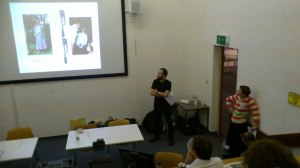 These are some of my favourite words and phrases used during the Photography and Artists’ Book Symposium in Manchester (October 21, 2011).
But do they offer any help to the working photographer?
The Photographic Essay, Photographic Novel and other Narrative Form
The Symposium, at Manchester Metropolitan University’s Special Collections and run jointly by the University of Salford and the MMU, examined the role of the photo book in photography. Or something like that.
The Symposium, held in a hot-house auditorium revealed some fascinating practices from some of the artists who presented their work. It was well run and included some fascinating points.
German Elisabeth Neudorfl from Folkwang University in Essen, presented a well-thought out book of photographs taken on a road in Manilla. David Penney from MMU presented a very personal work, hand-bound and too precious to him to actually be sold.
Each presentation by the nine speakers raised more questions for me than answers – and mainly in the area of sustainability, marketing and saleability (saleability might not be an actual word).
Can these artists’ books be produced with a view to making money?
The long answer includes observations that the photo book as an industry is almost unsustainable, hardly any photo books actually make a profit and photo books are do not have profit as their primary function. I won’t go into this for now.
But it became apparent very quickly at the Symposium that the books by the academics were books for academics, and perhaps more specifically books for the academics who made them.
The speakers at the Symposium fell into to categories: those whose artists’ books supported academic theory and those who produced items for public consumption.
This latter group – whose publications had public consumption in mind – consisted of only two speakers, Ian Beesley and the double act of Adam Murray and Diane Smyth.
Beesley presented his excellent book on Yorkshire miners called The Drift. It is professionally published and available for £15. Interestingly, several of his other books were published with the aid of grants.
Murray, the pioneer behind Preston Is My Paris publishing, and the British Journal of Photography writer Smyth talked about various Preston Is My Paris publications.
Despite being an admirer of Murray’s work and his desire to promote photography to a wider audience, I disagree with him strongly over his ideology in how to do this.
Murray believes in giving his work away for free and scorns those who either aim to make profit or gain self-promotion from zines or short-run publications in, say, news print.
All but one speaker at the symposium (Logan Sisley from Dublin Art Gallery) are funded by Universities. None – except perhaps the most accomplished photographer on show (Beesley) had produced their work entirely independently.
I don't think any of the other books on show would exist without an academic salary.
This is not a poor business model, it is a non-existent one. Murray’s insistence that his work should be given away for free could be seen as commendable but in reality it devalues the work of other photographers whose sole incomes come from editorial work, or magazine and zine production.
Editorial photography in all its forms has been hacked away at from all angles in recent years. The photo book in a self-published form has offered a glimmer of hope that long-term projects can become sustainable in the future. The coming of the ephotobook further enhances this prospect. But that reality is still a long way off for most photographers.
But to give work away for free – and essentially in publications paid for (or at least backed-up) by the university day job – is not how I would like to see academia helping my profession.
If all academia can offer the photo book genre, and photography as a whole, is naval gazing and cross-university back-slapping then it is failing to fulfill its wider role in society. Photo books, promoted so well by sites like Self Publish, Be Happy, face an uncertain future. How do they survive is the crucial question.
The next symposium should be The Photographic Essay, Photographic Novel and other Narrative Forms as a Sustainable Business Model for Professional Photographers Financing Long-Term Projects in Socio-Economic Structures Without False Aid from Academic Sources. Or something equally snappy.
NOTE: The Curious Action of the Vernacular Hand was my favourite phrase from the symposium. I believe it was spoken by Tim Daly of the University of Chester.
Super imposed typography
Visual narrative
Equivoque
Visual sharing
Appropriating photographs
Domestic landscapes
Vernacular architecture
Detritus
Re-purposing
Deskilling
Continuum
Literary photograph
Eschewing
Visual singulana
Oscillation
Sub-text
Ephemerality
Prosaic in content
Visual lexicon
Printed page as an empty signifier

But do they offer any help to the working photographer?
The Photographic Essay, Photographic Novel and other Narrative Form
The Symposium, at Manchester Metropolitan University’s Special Collections and run jointly by the University of Salford and the MMU, examined the role of the photo book in photography. Or something like that.
The Symposium, held in a hot-house auditorium revealed some fascinating practices from some of the artists who presented their work. It was well run and included some fascinating points.
German Elisabeth Neudorfl from Folkwang University in Essen, presented a well-thought out book of photographs taken on a road in Manilla. David Penney from MMU presented a very personal work, hand-bound and too precious to him to actually be sold.
Each presentation by the nine speakers raised more questions for me than answers – and mainly in the area of sustainability, marketing and saleability (saleability might not be an actual word).
Can these artists’ books be produced with a view to making money?
The long answer includes observations that the photo book as an industry is almost unsustainable, hardly any photo books actually make a profit and photo books are do not have profit as their primary function. I won’t go into this for now.
But it became apparent very quickly at the Symposium that the books by the academics were books for academics, and perhaps more specifically books for the academics who made them.
The speakers at the Symposium fell into to categories: those whose artists’ books supported academic theory and those who produced items for public consumption.
This latter group – whose publications had public consumption in mind – consisted of only two speakers, Ian Beesley and the double act of Adam Murray and Diane Smyth.
Beesley presented his excellent book on Yorkshire miners called The Drift. It is professionally published and available for £15. Interestingly, several of his other books were published with the aid of grants.
Murray, the pioneer behind Preston Is My Paris publishing, and the British Journal of Photography writer Smyth talked about various Preston Is My Paris publications.
Despite being an admirer of Murray’s work and his desire to promote photography to a wider audience, I disagree with him strongly over his ideology in how to do this.
Murray believes in giving his work away for free and scorns those who either aim to make profit or gain self-promotion from zines or short-run publications in, say, news print.
All but one speaker at the symposium (Logan Sisley from Dublin Art Gallery) are funded by Universities. None – except perhaps the most accomplished photographer on show (Beesley) had produced their work entirely independently.
I don't think any of the other books on show would exist without an academic salary.
This is not a poor business model, it is a non-existent one. Murray’s insistence that his work should be given away for free could be seen as commendable but in reality it devalues the work of other photographers whose sole incomes come from editorial work, or magazine and zine production.
Editorial photography in all its forms has been hacked away at from all angles in recent years. The photo book in a self-published form has offered a glimmer of hope that long-term projects can become sustainable in the future. The coming of the ephotobook further enhances this prospect. But that reality is still a long way off for most photographers.
But to give work away for free – and essentially in publications paid for (or at least backed-up) by the university day job – is not how I would like to see academia helping my profession.
If all academia can offer the photo book genre, and photography as a whole, is naval gazing and cross-university back-slapping then it is failing to fulfill its wider role in society. Photo books, promoted so well by sites like Self Publish, Be Happy, face an uncertain future. How do they survive is the crucial question.
The next symposium should be The Photographic Essay, Photographic Novel and other Narrative Forms as a Sustainable Business Model for Professional Photographers Financing Long-Term Projects in Socio-Economic Structures Without False Aid from Academic Sources. Or something equally snappy.
NOTE: The Curious Action of the Vernacular Hand was my favourite phrase from the symposium. I believe it was spoken by Tim Daly of the University of Chester.


 And Issue One of Love Town is still available: